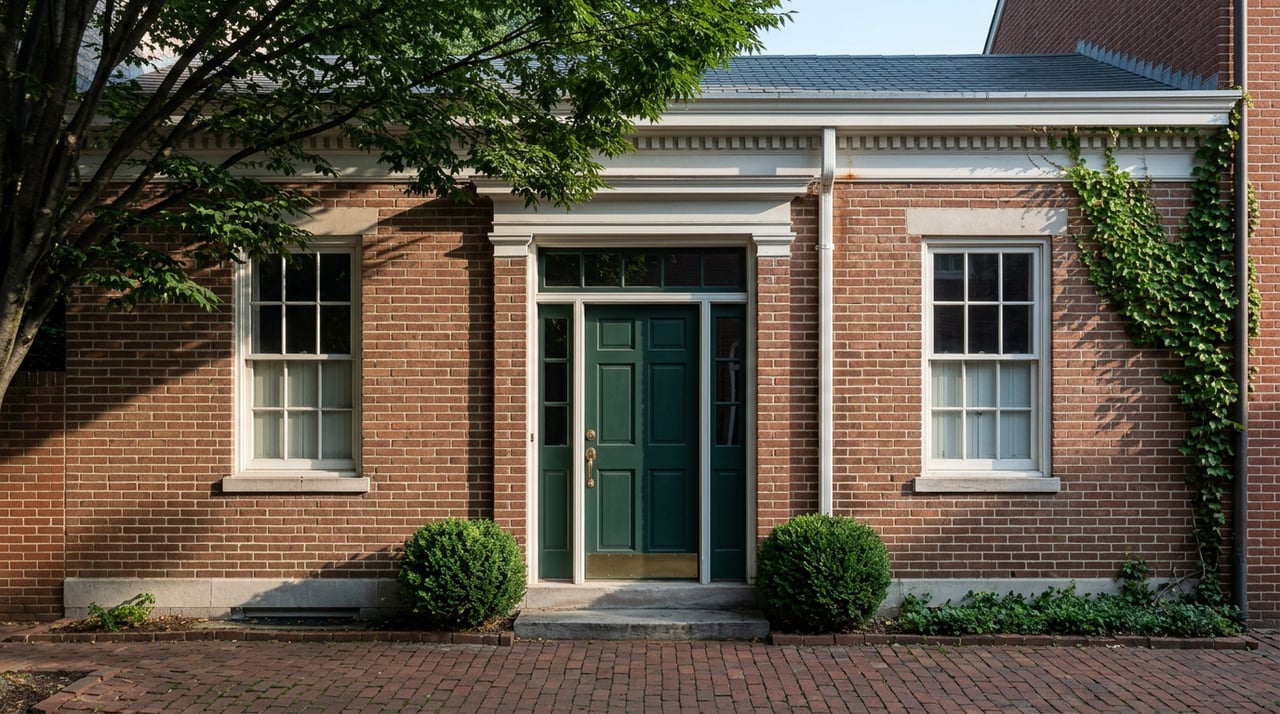
"We do not want to design a historic building, at all."
That was architect John Hutchison, standing before Chestertown's Historic District Commission on March 4, 2026, defending a plan to replace the burned-out shell of the old riverfront restaurant at 98 Cannon Street with a two-story building holding a restaurant, conference space, and ten guest rooms. Read on its own, the line sounds like an architect trying to talk his way around preservation rules. It's the opposite. Hutchison was quoting the town's own design guidelines back to the commission that wrote them, arguing that a new building compatible with Chestertown's historic fabric shouldn't pretend to be something it isn't. The commission granted conditional approval that night, but only after questioning him on viewsheds near the Captain James F. Taylor House, built around 1857, and the neighboring Hynson-Ringgold House, and after factoring in a Chester River floodplain requirement that pushed the building's ground floor close to ten feet above grade.
If a licensed architect representing a waterfront redevelopment has to argue his case sentence by sentence, a homeowner planning to swap a porch rail or repaint a facade a different color should assume the same commission has jurisdiction, because it's the same rule for both. And that rule is narrower than most buyers realize until they're already holding the keys.
The Word "Maintenance" Does Less Work Than You'd Think
Chestertown's own Historic District Design Guidelines are direct about where the line sits: "Any work done to the exterior of a structure (including landscaping) that alters that structure in any way is not considered routine maintenance." Read that closely. It doesn't say structural changes, or additions, or demolitions. It says anything that alters the exterior in any way.
In practice, that means repainting trim the same color, or replacing a rotted board with matching material, stays out of the review process. Changing that color, swapping a wood window sash for vinyl, installing a different style of fence, or reshaping a foundation bed all fall on the other side of the line, the side that requires a permit application and a hearing in front of the seven-member volunteer Historic District Commission. Chestertown created that commission when it passed one of Maryland's earliest local historic preservation ordinances, and the framework has been in place long enough that it predates most current owners' purchase dates by decades.
Three Renovation Paths, Three Different Reviewers
Not every project answers to the same authority, and knowing which lane you're in changes your timeline before you sign a contractor.
| Scope of work | Who reviews it | What you need |
|---|---|---|
| Any exterior alteration (color, materials, fencing, yard changes) | Chestertown Historic District Commission | Permit application and a hearing at a monthly meeting |
| Interior work only, no state tax credit sought | No town-level historic review | Standard building permit |
| Interior and exterior work, claiming the Maryland Historic Preservation Tax Credit | Maryland Historical Trust and the town HDC, separately | Two applications, reviewed under two sets of standards |
That last row surprises people the most. A full interior renovation, gutting a kitchen or reconfiguring bedrooms, doesn't need HDC approval at all. It's exempt. The only reason interior work ever comes under review is if the owner wants to claim the state's tax credit, which covers 20 percent of qualifying project costs. In that case the Maryland Historical Trust reviews both the interior and exterior, using its own standards, which can differ from Chestertown's local guidelines. The town's guidance to owners is specific about sequencing: apply for the tax credit review before you request the local building permit, not after, because reversing course once the town has already weighed in gets harder.
What a Denial Actually Costs You
Most applications that come before the commission get approved. That fact tends to make people treat the hearing as a formality. It isn't one for the minority who get turned down. A denied application has three paths forward: revise the plan to meet the commission's concerns and resubmit, wait a full year and resubmit the same plan unchanged, or appeal the decision to circuit court. There's no fast middle option. A rejected fence design in April doesn't get fixed in May. If your renovation plans depend on commission sign-off and the first submission misses the mark, you're either redesigning immediately or waiting out a full calendar year, which can push a project meant for one building season into the next.
What the 98 Cannon Case Reveals About Scale
The 98 Cannon hearing is useful precisely because it wasn't about a homeowner's shutters. The site had sat vacant since a 2022 fire closed the previous restaurant, and owner Don Urgo's redevelopment plan carried real civic weight, which is why the room was full and public comment ran long. Most residents who spoke supported the project as an economic boost for the town. But the commission's questions weren't about enthusiasm. They centered on whether the new building's mass and height would interrupt scenic views tied to two historic properties nearby, and on how a FEMA-driven elevation requirement, meant to keep the ground floor above flood risk, factored into the building's overall footprint. The Historic District Commission has authority over the location, height, and design of the project. A separate Planning Commission handles the parking plan, and the design has to return to the HDC again once the Planning Commission signs off. Two town bodies, two rounds of review, before a shovel goes in the ground.
The scale is different for a rowhouse buyer replacing a fence. The process isn't. Same commission, same guidelines, same standard: does this change fit the historic character of what's already standing nearby.
The Financial Piece the Listing Sheet Won't Mention
For owners of commercial buildings in the historic downtown, Main Street Chestertown's Facade Improvement Grant program offers matching funds for exterior work, covering up to half the project cost, with grants running from a $2,000 minimum to a $20,000 maximum, plus a full dollar-for-dollar match on the first $1,000 spent. That money comes with its own approval chain too: the Main Street review panel decides first, and the applicant still needs sign-off from both the Maryland Historical Trust and the town's Historic District Commission before reimbursement is issued. It's not automatic, and it's not fast, but it's real money that owners who treat the review process as pure obstacle tend to never apply for.
For a residential buyer, the lesson isn't the commercial grant itself. It's the mindset behind it. The HDC review isn't only a cost to plan around. Layered correctly, with the tax credit application filed first and the right documentation ready for the hearing, it can be part of how a renovation gets funded, not just approved.
Before You Write the Offer
Chestertown's historic downtown holds one of the largest concentrations of restored 18th and 19th century homes on the Eastern Shore, including landmarks like the White Swan Tavern on High Street, dated to around 1733, and Widehall, the 1770 Georgian home built by merchant Thomas Smythe. That density is a large part of what draws buyers here. It also means "cosmetic" and "routine" carry a narrower definition inside the district boundary than they do a few blocks outside it.
If you're considering a property in Chestertown's historic district and already have renovation plans in mind, whether that's a new fence, a different exterior color, or a full rehab aimed at the state tax credit, the smart move is finding out what's reviewable before you're under contract, not after. That's a conversation worth having early, and it's one we have with buyers regularly.
Have questions about a specific address in Chestertown's historic district? Let's Connect and we'll help you understand what a property will and won't let you change before you make an offer.
FAQ
Does interior renovation in a Chestertown historic district home need town approval? No. Chestertown's historic zoning ordinance applies only to exteriors. Interior work only comes under any kind of review if you're applying for the Maryland Historic Preservation Tax Credit, in which case the Maryland Historical Trust, not the town, reviews the interior changes.
Is repainting my house considered routine maintenance under Chestertown's rules? Only if it's in-kind. The town's design guidelines state that any exterior work that alters the structure in any way, which includes changes to the yard, doesn't count as routine maintenance. A straight repaint in the same color is generally treated as upkeep. A color change is worth checking with the town before you buy the paint.
What happens if the Historic District Commission denies a renovation application? You have three options: revise the plan to address the commission's concerns and resubmit, wait a full year and resubmit the same application unchanged, or appeal the decision to circuit court. There's no quick resubmission path, so a denial can meaningfully delay a project timed to a specific building season.